The Morning Starts the Night Before: Why Your Evening Wind-Down Matters
Share
The final few hours of the day are a transition point. Light begins to fall, stimulation should gradually decrease, and the body starts preparing for sleep. Yet modern evenings often move in the opposite direction: bright screens, late emails, endless scrolling and one more episode before bed.
Creating a deliberate evening wind-down isn't about constructing a complicated wellness
routine. It's about giving the body consistent signals that the active part of the day is ending.
And when you protect those evening hours, you may find that mornings begin to feel
different too.
The Science of the Evening Wind-Down
Your body runs on an internal 24-hour timing system called the circadian rhythm. It helps coordinate everything from the sleep-wake cycle to hormone release and body temperature.
One of its strongest environmental signals is light.
A systematic review examining light exposure and sleep found that the amount and timing of light can influence sleep outcomes. In simple terms, our brains pay attention to whether the environment looks like day or night.
That is why the transition into evening matters.
As natural light disappears, reducing bright artificial light and stimulation can help reinforce the distinction between daytime activity and night-time rest.
The routine itself matters too. A 2024 review examining 548 adult sleep-hygiene studies found that sleep timing, light, wind-down routines and stress were among the factors commonly considered in sleep hygiene research.
The goal isn't to force yourself to sleep.
It's to create the conditions that make switching off easier.
Why Tomorrow's Energy Begins Tonight
We often respond to a difficult morning by adding more stimulation.
More caffeine. A stronger coffee. A harder workout. More pressure to be productive.
But sometimes the better question is:
What happened the night before?
Sleep is part of the body's recovery cycle. A consistent sleep-wake pattern also helps reinforce the body's internal timing.
In a large UK Biobank study involving 88,975 people, researchers found an association between greater sleep regularity and lower risk of all-cause mortality. The study doesn't mean that one late night is harmful; rather, it adds to growing evidence that consistency matters when thinking about sleep and long-term health.
Your evening routine therefore isn't separate from tomorrow's performance.
It is part of it.
The 3-Hour Landing Strip
Instead of thinking about bedtime as an abrupt stop, imagine the final few hours of the day as a landing strip.
You don't need to go from 100 to zero the second your head hits the pillow. Give yourself space to gradually reduce the inputs keeping your brain in daytime mode.
Three hours before bed: lower the intensity
This is where the pace of the day can begin to change.
Finish demanding work where possible. Move away from highly stimulating tasks. Lower the
lights. Choose slower activities.
You don't need complete silence or darkness at 7pm. The aim is simply to start creating contrast between your day and your evening.
This can also be the perfect point for a warm evening drink.
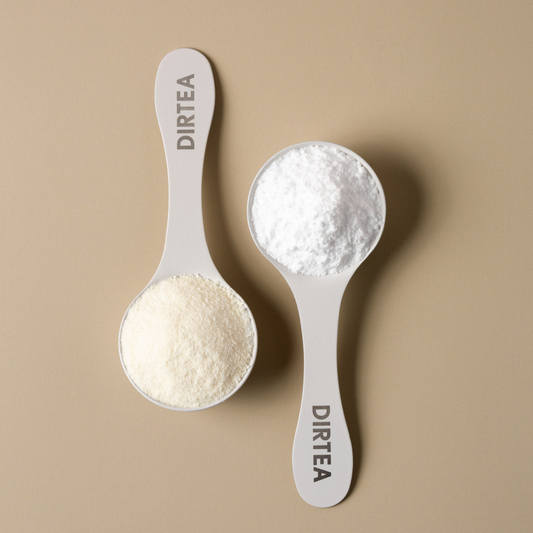
DIRTEA Cacao combines raw cacao with functional mushrooms including Lion's Mane, Tremella and Reishi, alongside an organic B-vitamin complex.
Rich, warming and chocolatey, it can turn the transition out of work mode into something tangible: make the drink, put the laptop away and let the evening begin.
Rather than treating a wind-down as another task to complete, attach it to something you genuinely look forward to.
Two hours before bed: reduce stimulation
Your environment matters.
Bright light late in the evening can send a very different signal to the brain than the gradual darkness humans evolved around.
Dim overhead lighting where possible and use warmer, softer lamps. If you're going to use a phone or laptop, reduce the brightness or use warmer night-time display settings.
Then look beyond light.
What are you consuming mentally?
Work emails, breaking news and rapid-fire social media can keep the mind engaged long after the screen goes dark.
Try replacing at least some of that stimulation with something slower: reading, stretching, conversation, journalling, a warm shower or simply preparing for the following day.
The objective isn't perfection.
It's deceleration.
One hour before bed: create a repeatable signal
The best evening routine is rarely the most elaborate one.
It's the one you actually repeat.
That might be putting your phone on charge outside the bedroom, washing your face, making tomorrow's to-do list and reading for 20 minutes.
You can also build a consistent supplement ritual into this window.
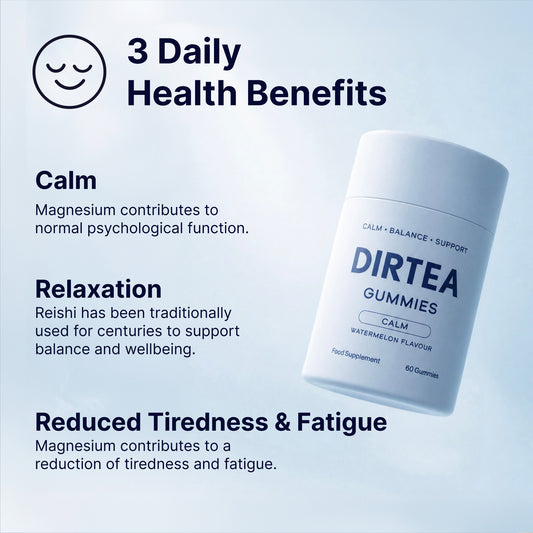
DIRTEA Calm Gummies combine Reishi mushroom extract with magnesium citrate.
Magnesium contributes to normal psychological function and helps reduce tiredness and fatigue, making the gummies an easy addition to an evening wellbeing routine.
The important distinction is that these products shouldn't be viewed as an instant switch that “makes you sleep”.
Think ritual, not remedy.
The act of repeating the same behaviours each evening can become part of a familiar signal that the day is ending.
Your Environment Is Part of the Ritual
What you take is only one part of a wind-down.
What surrounds you matters too.
Your environment is continuously providing information to your brain:
Bright or dim.
Loud or quiet.
Active or still.
Work or rest.
Try making the environment itself part of your evening ritual.
Lower the lights. Reduce unnecessary notifications. Keep your bedroom cool, dark and comfortable. Put tomorrow's clothes out. Write down anything you're worried you'll forget.
Move stimulating conversations and work away from the final minutes before bed where possible.
Small actions can create a clearer boundary between today and tomorrow.
And this is where an evening ritual becomes more than a single product or habit.
It's the combination of signals that matters.
Consistency Beats the Perfect Bedtime Routine
There is no universal evening routine that everyone needs to follow.
Some people love meditation. Others would rather read. Some want a warm Cacao. Others prefer Calm Gummies and ten quiet minutes away from their phone.
What matters more is creating a rhythm your body begins to recognise.
Your circadian system responds to patterns.
Light at roughly the same time.
Food at roughly the same time.
Activity at roughly the same time.
Sleep and waking at roughly the same time.
The more predictable those signals become, the clearer the distinction between active hours and recovery hours can become.
You don't need a two-hour wellness ceremony.
You need cues you can repeat.
A Simple DIRTEA Evening Ritual
Your wind-down doesn't need ten steps.
It could be as simple as this:
Early evening: Finish demanding work where possible. Lower the lights and begin reducing stimulation.
Around 90–120 minutes before bed: Make a warm DIRTEA Cacao. Put your laptop away and use the ritual of preparing your drink as the point where work ends and your evening begins.
Later in the evening: Take the Calm gummies as part of your normal night-time routine.
Final 30–60 minutes: Reduce screens where possible. Read, stretch, journal, shower or simply spend some time without another stream of information arriving.
Bedtime: Aim for a reasonably consistent sleep and wake time.
Simple. Repeatable. Sustainable.
Final Thoughts: The Real Secret to a Better Morning
There is a tendency to think of morning and evening routines as two separate things.
They aren't.
Your evening is the beginning of your morning routine.
A calmer final hour may mean you aren't carrying work straight into bed. A consistent bedtime can help reinforce a predictable sleep-wake rhythm. Reducing bright light can help create a clearer distinction between day and night.
And perhaps most importantly, an evening ritual gives you permission to stop.
Modern life makes it remarkably easy to remain switched on until the moment you fall asleep. There is always another message, episode, email or piece of content waiting.
A wind-down creates a boundary.
Today is finished. Tomorrow can wait.
FAQs
Why is an evening wind-down important?
An evening wind-down creates a transition between daytime activity and sleep. Reducing stimulation, managing evening light exposure and following relatively consistent sleep and wake times can all form part of healthy sleep habits.
How long should you wind down before bed?
There is no single perfect duration. For many people, gradually reducing stimulation over the final one to two hours before bed is more realistic than trying to switch off immediately.
Which DIRTEA products are best suited to an evening routine?
DIRTEA Cacao and Calm Gummies can all be incorporated into an evening ritual. Cacao creates a warming drink ritual, while Calm Gummies offer a different way to incorporate Reishi into your routine.
Does Reishi make you sleepy?
Reishi is not a sedative or sleeping medication. It has a long history of traditional use in East Asian wellness practices and can be incorporated into an evening ritual, but it shouldn't be viewed as something that instantly makes you fall asleep.
Should I avoid screens before bed?
You don't necessarily need to eliminate every screen. However, reducing bright light and highly stimulating content as bedtime approaches can help create a clearer distinction between daytime activity and the evening. Lowering screen brightness, using warmer display settings and spending part of your wind-down away from devices are simple places to start.
Can an evening routine help me feel better in the morning?
How you feel in the morning is influenced by many factors, including sleep duration, sleep quality and sleep-wake consistency. A repeatable evening routine can help create conditions that support a more consistent sleep schedule rather than relying solely on morning stimulation to compensate for a late or disrupted night.
References
Dautovich, N. D., Schreiber, D. R., Imel, J. L., Tighe, C. A., Shoji, K. D., Cyrus, J., Bryant, N., Lisech, A., O'Brien, C., & Dzierzewski, J. M. (2019). A systematic review of the amount and timing of light in association with objective and subjective sleep outcomes in community-dwelling adults. Sleep Health, 5(1), 31–48. https://doi.org/10.1016/j.sleh.2018.09.006
Masterton, A., Drummond, S. P. A., & Bin, Y. S. (2024). Sleep hygiene – What do we mean? A bibliographic review. Sleep Medicine Reviews, 75, 101930. https://doi.org/10.1016/j.smrv.2024.101930
Cribb, L., Sha, R., Yiallourou, S., Grima, N. A., Cavuoto, M., Baril, A.-A., & Pase, M. P. (2023). Sleep regularity and mortality: A prospective analysis in the UK Biobank. eLife, 12, e88359. https://doi.org/10.7554/eLife.88359